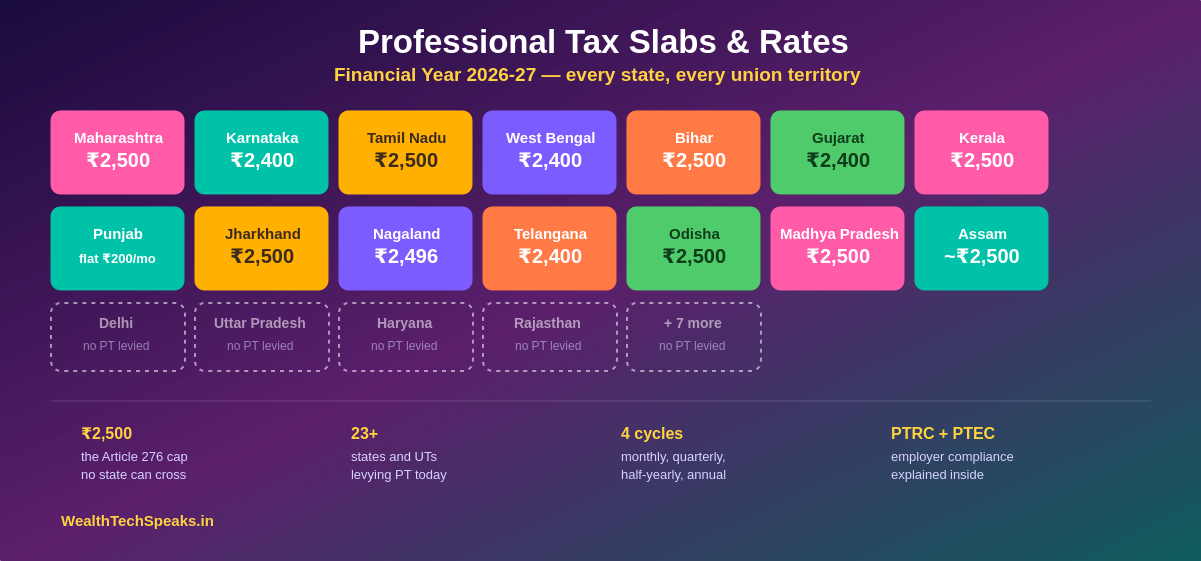
Professional Tax Slabs & Rates- Financial Year 2026-27
- Posted By Amritesh
- On June 30th, 2026
- Comments: no responses
Professional Tax (PT) continues to be one of the most misunderstood line items on an Indian salary slip. It’s small in absolute value — capped at ₹2,500 a year — yet professional tax slab rates trip up payroll teams, freelancers, and salaried employees alike because there is no single PT law. Each State Legislature frames its own Act, sets its own professional tax slab, and decides its own payment frequency. What applies in Mumbai may not apply in Gurugram, and what applies in Chennai is calculated completely differently from Bengaluru.
This article builds on our earlier state-wise Professional Tax coverage on WealthTech Speaks and focuses specifically on what’s changed and what’s missing from a typical “professional tax slab rates” list: the constitutional mechanics, exact FY 2026-27 numbers in tabular form (not just images), the newly restructured Punjab State Development Tax, the work-location-vs-registered-office trap that’s catching multi-state and remote employers off guard, employer-side compliance obligations (PTRC/PTEC), state-wise penalty structures, and how professional tax interacts with the old vs new tax regime choice.
Constitutional and Legal Basis
Professional Tax does not originate from a central statute. Two Articles of the Constitution explain why it looks so different from state to state:
- Article 246 gives Parliament exclusive power to legislate on subjects in the Union List, which includes tax on income.
- Article 276 carves out a specific exception: State Legislatures may levy taxes on professions, trades, callings, and employment, subject to a ceiling of ₹2,500 per person per year.
Because PT sits in the State List, levying it is optional — a state can choose not to enact a PT Act at all (Delhi, Uttar Pradesh, Haryana, and Rajasthan have made exactly that choice). Where a state does levy it, the ₹2,500 ceiling is absolute; no amendment to a state slab can push the annual liability above that figure, which is why so many states cap out at ₹2,400 or land on awkward numbers like “₹200 for eleven months and ₹300 in February” — it’s arithmetic engineered to land exactly at the constitutional limit.
State-Wise Professional Tax Slabs & Rates for FY 2026-27
Maharashtra
Governed by the Maharashtra State Tax on Professions, Trades, Callings and Employments Act, 1975.
| Monthly Gross Salary | Monthly PT |
| Up to ₹7,500 | Nil |
| ₹7,501 – ₹10,000 | ₹175 |
| Above ₹10,000 | ₹200 (₹300 in February) |
Annual PT = ₹2,500 (₹200 × 11 + ₹300 in February). Women drawing salary up to the exemption threshold notified by the state are exempt from PT — always confirm the current threshold via the Maharashtra GST/Commercial Tax Department before processing payroll, since this exemption slab has moved more than once in recent years.
Karnataka
Governed by the Karnataka Tax on Professions, Trades, Callings and Employments Act, 1976.
| Monthly Gross Salary | Monthly PT |
| Up to ₹25,000 | Nil |
| ₹25,001 – ₹41,999 | ₹150 |
| ₹42,000 and above | ₹200 |
Annual PT = up to ₹2,400. Returns are filed monthly on the Khajane-2 portal.
Andhra Pradesh
Governed by the Andhra Pradesh Tax on Professions, Trades, Callings and Employments Act, 1987.
| Monthly Gross Salary | Monthly PT |
| Up to ₹15,000 | Nil |
| ₹15,001 – ₹20,000 | ₹150 |
| Above ₹20,000 | ₹200 |
Annual PT = up to ₹2,400.
Telangana
Continues with a structure inherited from undivided Andhra Pradesh post-2014 bifurcation, under the Telangana Tax on Professions, Trades, Callings and Employments Act.
| Monthly Gross Salary | Monthly PT |
| Up to ₹15,000 | Nil |
| ₹15,001 – ₹20,000 | ₹150 |
| Above ₹20,000 | ₹200 |
Annual PT = up to ₹2,400.
Tamil Nadu
Levied half-yearly, not monthly, under the Tamil Nadu municipal laws governing the levy. Paid in August (for April–September) and January (for October–March), and remitted to local bodies — Municipal Corporations or Municipalities — rather than a single state treasury.
| Half-Yearly Gross Income | Half-Yearly PT |
| Up to ₹21,000 | Nil |
| ₹21,001 – ₹30,000 | ₹135 |
| ₹30,001 – ₹45,000 | ₹315 |
| ₹45,001 – ₹60,000 | ₹690 |
| ₹60,001 – ₹75,000 | ₹1,025 |
| Above ₹75,000 | ₹1,250 |
Annual PT = up to ₹2,500.
West Bengal
Governed by the West Bengal State Tax on Professions, Trades, Callings and Employments Act, 1979.
| Monthly Gross Salary | Monthly PT |
| Up to ₹10,000 | Nil |
| ₹10,001 – ₹15,000 | ₹110 |
| ₹15,001 – ₹25,000 | ₹130 |
| ₹25,001 – ₹40,000 | ₹150 |
| Above ₹40,000 | ₹200 |
Annual PT = up to ₹2,400. Employer PT for the full financial year is due by 31st July.
Gujarat
Governed by the Gujarat Panchayats, Municipalities, Municipal Corporations and State Tax on Professions, Trades, Callings and Employments Act, 1976.
| Monthly Gross Salary | Monthly PT |
| Up to ₹5,999 | Nil |
| ₹6,000 – ₹8,999 | ₹80 |
| ₹9,000 – ₹11,999 | ₹150 |
| ₹12,000 and above | ₹200 |
Annual PT = up to ₹2,400.
Kerala
Levied half-yearly under the Kerala Panchayat Raj Act and Kerala Municipality Act, due by September 30 and March 31.
| Half-Yearly Gross Income | Half-Yearly PT |
| Up to ₹11,999 | Nil |
| ₹12,000 – ₹17,999 | ₹120 |
| ₹18,000 – ₹29,999 | ₹180 |
| ₹30,000 – ₹44,999 | ₹300 |
| ₹45,000 – ₹59,999 | ₹450 |
| ₹60,000 – ₹74,999 | ₹600 |
| ₹75,000 – ₹99,999 | ₹750 |
| ₹1,00,000 – ₹1,24,999 | ₹1,000 |
| Above ₹1,25,000 | ₹1,250 |
Annual PT = up to ₹2,500.
Madhya Pradesh
Levied under the MP Vritti Kar Adhiniyam, 1955, and collected quarterly.
| Monthly Gross Salary (effective) | Monthly PT |
| Up to ₹18,750 | Nil |
| ₹18,751 – ₹25,000 | ₹125 |
| ₹25,001 – ₹33,333 | ₹167 |
| Above ₹33,333 | ₹208 |
Annual PT = up to ₹2,500, payable in quarterly instalments by the last day of the month following each quarter (June 30, September 30, December 31, March 31).
Odisha
Levied under the Orissa State Tax on Professions, Trades, Callings and Employments Act, 2000.
| Monthly Gross Salary | Monthly PT |
| Up to ₹13,304 | Nil |
| ₹13,305 – ₹25,000 | ₹125 |
| ₹25,001 – ₹41,666 | ₹167 |
| Above ₹41,666 | ₹208 |
Annual PT = up to ₹2,500.
Assam
Levied under the Assam Tax on Professions, Trades, Callings and Employment Act, 1947, with the salaried-employee slab confirmed directly from the Assam Commissionerate of Taxes’ published rate schedule (effective from 15th October 2014 and still current).
| Monthly Salary/Wages | Monthly PT |
| Up to ₹10,000 | Nil |
| ₹10,000 – ₹15,000 | ₹150 |
| ₹15,000 – ₹25,000 | ₹180 |
| ₹25,000 and above | ₹208 |
Annual PT = up to ₹2,496 (₹208 × 12), just under the constitutional ceiling. Self-employed professionals (lawyers, doctors, chartered accountants, engineers, and similar) are taxed separately on an annual-income basis, ranging from nil below ₹1,20,000 to ₹2,500 at ₹3,00,000 and above. Late payment attracts a 2% monthly penalty.
Bihar
This is a state worth flagging specifically, because several payroll references incorrectly mark it as suspended for FY 2026-27 — it is not. Bihar levies PT under the Bihar State Tax on Professions, Trades, Callings and Employment Act, 2011, and the slab structure is unusual in two respects: it is assessed on annual income, not monthly salary, and the due date sits at the very end of the calendar year rather than tying to the financial year close.
| Annual Income | Annual PT |
| Below ₹3,00,000 | Nil |
| ₹3,00,000 and above | ₹1,000 to ₹2,500 (graded by income band) |
PT deducted in September must be deposited by 15th November, with the annual return due by 30th November — a due-date pattern that doesn’t resemble any other state on this list, and one that’s easy for a multi-state payroll calendar to miss.
Jharkhand
Levied on annual income rather than monthly salary, collected quarterly.
| Annual Income | Annual PT |
| Up to ₹3,00,000 | Nil |
| ₹3,00,001 – ₹5,00,000 | ₹1,200 |
| ₹5,00,001 – ₹8,00,000 | ₹1,800 |
| ₹8,00,001 – ₹10,00,000 | ₹2,100 |
| Above ₹10,00,000 | ₹2,500 |
Punjab Professional Tax — the structural change most lists miss
Punjab does not have a “Professional Tax Act” in the traditional sense any more. It operates the Punjab State Development Tax (PSDT), introduced under the Punjab State Development Tax Act, 2018, applicable to anyone who is an income-tax payer in the state.
| Particulars | Amount |
| Monthly deduction | Flat ₹200/month |
| Annual liability | ₹2,400/year |
| Lump-sum annual option | Approx. ₹2,200/year (a discount over monthly deduction, if paid early as a lump sum) |
| Due date | 15th of the following month |
| Exemption | Senior citizens aged 60+ generally exempt |
This is a meaningfully different mechanism from a slab-based PT — there’s no income-tiering at all; liability is determined purely by whether the person is an income-tax assessee, not by which salary band they fall into. Several generic “state-wise PT” articles still describe Punjab as having no PT, which was true before 2018 but is outdated now.
Nagaland Professional Tax — frequently and incorrectly listed as “no PT”
This is worth a direct correction, because it’s a mistake repeated across a striking number of payroll and HR reference sites: Nagaland does levy Professional Tax. It is one of the longer-standing PT regimes in the Northeast, governed by the Nagaland State Tax on Professions, Trades, Callings and Employment Act, and administered by the Nagaland Department of Taxes. The official rate schedule published by the department confirms a conventional monthly slab for salary and wage earners:
| Monthly Salary/Wages | Monthly PT |
| Below ₹4,000 | Nil |
| ₹4,000 – ₹5,000 | ₹35 |
| ₹5,000 – ₹7,000 | ₹75 |
| ₹7,000 – ₹9,000 | ₹110 |
| ₹9,000 – ₹12,000 | ₹180 |
| ₹12,000 and above | ₹208 |
Beyond salaried employees, Nagaland’s Act is unusually granular for a state of its size — it sets separate annual rates for legal practitioners, medical practitioners, chartered accountants and other technical consultants (graded by years of standing in the profession, from ₹500 to ₹2,000/year), insurance agents, stockbrokers, contractors graded by annual business turnover, company directors, dealers under the state GST/VAT Acts, transport permit holders, and even specific categories like beauty parlours, cinema halls, and internet cafés — most landing at or near the ₹2,500 annual ceiling. Persons below 18 or above 60 are exempt, and registration (Form I) must be filed within 30 days of crossing the ₹4,000/month threshold.
Manipur Professional Tax — another state commonly mismarked as “no PT”
Manipur belongs alongside Nagaland on the corrections list. It levies Professional Tax under the Manipur State Tax on Professions, Trades, Callings and Employments Act (the Act has been referenced with both a 1975 and a 1981 commencement date across different government documents, and has been amended multiple times since, most notably in 2012), administered by the Manipur Department of Taxes through its own online enrolment and payment portal.
What’s well-confirmed directly from the department’s own FAQ documentation:
| Particulars | Detail |
| Governing Act | Manipur State Tax on Professions, Trades, Callings and Employments Act |
| Registration | Certificate of Enrolment required within 90 days of starting a profession, trade, or employment (employers deduct and remit for salaried staff) |
| Payment cycle | Once per financial year, due by 30th September (or within one month of enrolment, if enrolled after 31st August) |
| Late payment interest | 2% per month (or part thereof) on the unpaid amount |
| Penalty for non-payment | Up to 200% of the tax due, after a hearing |
| Maximum annual liability | ₹2,500, consistent with the Article 276 ceiling |
For salaried employees specifically, several independent payroll references converge on a monthly-deduction figure of ₹208 for eleven months and ₹212 in the final month — landing exactly at the ₹2,500 annual ceiling. We’re flagging this rather than presenting it as fully verified: it’s repeated consistently across multiple sources, but a few other secondary sources show a slab table that appears to be a misattributed copy from Maharashtra’s PT schedule rather than Manipur-specific data. If you’re processing payroll in Manipur, confirm the exact current income-band schedule directly against the Gazette notification on the official portal before relying on any third-party figure, including this one.
Meghalaya, Tripura, Mizoram, Sikkim, Chhattisgarh, Puducherry
These smaller PT-levying jurisdictions follow broadly similar graded structures, but the payment cycle is not uniform across them — this is worth flagging because most slab-list articles imply everything outside the big states is “monthly” by default, which understates the variation. Sikkim and Meghalaya are commonly described as assessing PT on an annual basis rather than deducting it monthly; Chhattisgarh deducts monthly but requires employers to deposit the tax within ten days of month-end and runs a quarterly cycle for self-employed enrolled persons; Puducherry, India’s one PT-levying Union Territory, collects half-yearly, due by 31st July and 31st January.
Entry thresholds across this group broadly range from roughly ₹4,200 to ₹20,000 a month, with maximum monthly-equivalent deductions between ₹150 and ₹208. Because notifications for these states get less national coverage, always cross-check the current notified slab and payment cycle against the respective state’s Commercial Tax Department portal before finalising payroll, rather than relying on any single secondary source — including this one.
Goa — a state several lists wrongly mark as PT-applicable
This deserves the opposite correction to Nagaland and Manipur. Several payroll and compliance sites list Goa as currently levying Professional Tax, but the weight of evidence says otherwise: Goa’s own State Tax Department administers VAT, Central Sales Tax, Luxury Tax, Entry Tax, and Entertainment Tax — with no Professional Tax Act listed among them.
In 2024 State Government decision accepted a Finance Commission recommendation to introduce a professional tax to fund local panchayats and municipalities, which is very likely the source of the confusion: that proposal would require fresh legislation under Article 276 and, as of the most recent information available, had not yet been enacted as a functioning, collected tax. Until Goa’s government formally notifies a PT Act and a slab schedule, treat Goa as a non-PT state for payroll purposes, and watch for an official notification if you have employees based there.
States and Union Territories Where Professional Tax Is NOT Applicable
| Region | Status |
| Delhi (NCT) | No PT Act |
| Uttar Pradesh | No PT Act |
| Haryana | No PT Act |
| Rajasthan | No PT Act |
| Uttarakhand | No PT Act |
| Himachal Pradesh | No PT Act |
| Arunachal Pradesh | No PT Act |
| Goa | No PT Act currently in force (local-body PT approved in principle in 2024, not yet legislated) |
| Jammu & Kashmir | No PT Act |
| Ladakh | No PT Act |
| Chandigarh (UT) | No PT Act |
| Andaman & Nicobar Islands (UT) | No PT Act |
| Lakshadweep (UT) | No PT Act |
| Dadra and Nagar Haveli and Daman & Diu (UT) | No PT Act |
If your organisation has people on payroll in any of these locations, there is no PT deduction obligation, and no employer registration requirement, for those specific employees.
A word of caution on this list specifically: Nagaland and Manipur are commonly — and wrongly — included in “no PT” lists across payroll and HR reference material, when both actively levy it. Goa runs the opposite error: several sources wrongly list it as PT-applicable, when in fact no Professional Tax Act is currently in force there. See the dedicated sections above for all three, with the evidence behind each correction.
The Work-Location Trap: Registered Office vs Place of Employment
This is the single most consequential compliance point for any organisation with a distributed or hybrid workforce, and it’s the area where genuine financial exposure tends to hide.
PT applicability follows where the employee actually performs work, not where the company is registered or headquartered. A company headquartered in Delhi (a non-PT state) that has employees physically working from a Noida (Uttar Pradesh) office, a Gurugram (Haryana) office, or a Bengaluru (Karnataka) office must apply the PT rules of wherever those employees are actually sitting and working — not the rules of the registered-office state.
This has become a sharper risk since hybrid work normalised cross-state employment: an employee whose appointment letter says “Mumbai” but who has permanently relocated to and works from Jaipur creates ambiguity that payroll systems built around “registered office state” logic will get wrong by default. Misapplying this in either direction creates a problem — under-deduction creates a back-payment liability with interest once flagged in an audit or due-diligence review, and over-deduction in a non-PT state means money has been taken from an employee’s salary with no legal basis to do so.
Employer Compliance: PTRC and PTEC
Two distinct registrations apply to employers operating in PT-levying states, and conflating them is a common error:
- PTRC (Professional Tax Registration Certificate) — Required to legally deduct PT from employees’ salaries and remit it to the state. This must typically be obtained before the first payroll run in that state, generally within 30 days of becoming liable.
- PTEC (Professional Tax Enrolment Certificate) — A separate registration covering the employer’s own PT liability as a legal entity (company, firm, LLP), independent of what’s deducted from employees. PTEC usually requires annual renewal, and it’s the certificate most frequently missed in compliance audits because attention naturally gravitates toward the employee-deduction side.
For self-employed professionals — doctors, advocates, chartered accountants, consultants, freelancers — there is no “employer” to deduct PT on their behalf. They must register directly with the state’s commercial tax department and pay PT themselves, generally also via an enrolment certificate route, based on the income slab applicable to their state of practice.
Penalty and Interest Structures by State
Late registration, late deduction, and late remittance attract financial consequences that vary meaningfully by state — this is one area where a single “PT is capped at ₹2,500” headline understates the actual cost of non-compliance:
| State | Late Payment Interest | Penalty |
| Karnataka | 1.25% per month | Up to 50% of tax due |
| West Bengal | 1% per month | Up to 50% of tax due |
| Maharashtra | — | ₹5/day for late registration; 10% of tax due for late filing/payment |
| Bihar | — | ₹100/month of delay; up to ₹500 for rule violations; ₹10/day for continuing default |
| Jharkhand | — | ₹500–₹5,000, plus ₹10/day for continuing default |
| Punjab (PSDT) | 2% per month | Up to the amount of tax due, or ₹50/day of default |
| Manipur | 2% per month | Up to 200% of the tax due, after a hearing |
The pattern worth internalising: states with monthly slab-based PT (Karnataka, West Bengal) tend to charge ongoing interest, while states with annual/quarterly assessment (Bihar, Jharkhand) tend to charge flat or per-day penalties instead of compounding interest. Either way, the per-employee, per-month exposure can exceed the annual PT liability itself within a few months of non-compliance — which is precisely why due-diligence reviews (M&A, private equity, statutory audits) flag PT gaps disproportionately to the rupee amount actually owed.
How Professional Tax Interacts with Income Tax
This deserves precision, because guidance on this point is inconsistent across sources:
- PT paid by a salaried employee is deductible from gross salary under Section 16(iii) of the Income Tax Act.
- This deduction is available only under the old tax regime. If you’ve opted into the new tax regime under Section 115BAC, the standard deduction structure there does not carry forward the Section 16(iii) PT deduction — it’s one of the exemptions/deductions that the new regime trades away in exchange for lower slab rates.
- For a person in the old regime paying the full ₹2,500 annual PT, this translates to a modest but real tax saving — at the 30% slab, roughly ₹780 (plus applicable cess) reduction in tax liability.
Given that PT deduction is one of the smaller, easily overlooked items when comparing old vs new regime, it’s worth factoring into the regime-choice decision alongside HRA, 80C, and home loan interest — particularly for employees in high-PT states like Maharashtra or Tamil Nadu where the annual figure touches the ₹2,500 ceiling.
Exemptions from Professional Tax
Common categories of exemption, though the exact list and thresholds vary by state Act:
- Persons with a permanent physical disability, including blindness, where the respective state’s PT Act provides for it.
- Parents or guardians of a person with a disability, including mental retardation or other specified disabilities, where the Act extends the exemption.
- Senior citizens — typically above 65 years, though Karnataka sets this threshold at 60.
- Members of the Armed Forces under the Army, Navy, and Air Force Acts, in states that specifically exempt them (Bihar and Jharkhand both carve out exemptions for specified defence and paramilitary personnel).
- Badli or casual workers below a minimum income threshold, in select states.
- Women employees below a specified income threshold in Maharashtra — historically one of the more generous state-specific carve-outs, though the exact threshold has been revised periodically and should be verified against the current state notification rather than assumed.
A practical compliance point: incorrectly applying an exemption (deducting nothing when PT was actually due) is treated by most state authorities the same way as non-deduction — it attracts the same interest and penalty exposure as if no exemption had been claimed at all. Exemptions need to be verifiable against the current Act, not assumed from a prior year’s practice.
Quick Reference Table for FY 2026-27
| State / UT | Applicable | Frequency | Max Annual PT |
| Maharashtra | Yes | Monthly | ₹2,500 |
| Karnataka | Yes | Monthly | ₹2,400 |
| Andhra Pradesh | Yes | Monthly | ₹2,400 |
| Telangana | Yes | Monthly | ₹2,400 |
| Tamil Nadu | Yes | Half-Yearly | ₹2,500 |
| West Bengal | Yes | Monthly | ₹2,400 |
| Gujarat | Yes | Monthly | ₹2,400 |
| Kerala | Yes | Half-Yearly | ₹2,500 |
| Madhya Pradesh | Yes | Quarterly | ₹2,500 |
| Odisha | Yes | Monthly | ₹2,500 |
| Assam | Yes | Monthly | ₹2,496 |
| Bihar | Yes | Annual (Nov due date) | ₹2,500 |
| Jharkhand | Yes | Quarterly (annual slab) | ₹2,500 |
| Chhattisgarh | Yes | Monthly | ₹2,500 |
| Meghalaya | Yes | Annual | ₹2,500 |
| Tripura | Yes | Monthly | ₹2,400 |
| Sikkim | Yes | Annual | ₹2,400 |
| Puducherry (UT) | Yes | Half-Yearly | ₹2,500 |
| Punjab (PSDT) | Yes (restructured) | Monthly / Lump-sum | ₹2,400 |
| Nagaland | Yes (often mislabeled “no PT”) | Monthly | ₹2,496 (₹208 × 12) |
| Manipur | Yes (often mislabeled “no PT”) | Annual (Sept 30 due date) | ₹2,500 |
| Delhi | No | — | — |
| Uttar Pradesh | No | — | — |
| Haryana | No | — | — |
| Rajasthan | No | — | — |
| Uttarakhand | No | — | — |
| Himachal Pradesh | No | — | — |
| Goa | No (often mislabeled “yes”) | — | — |
| Arunachal Pradesh, J&K, Ladakh | No | — | — |
| Chandigarh, A&N Islands, Lakshadweep, DNH&DD (UTs) | No | — | — |
This table is a quick-reference summary. Always verify the current notified slab against the respective state’s commercial/professional tax department before finalising payroll, since individual slabs are revised by state notification and may change mid-year.
Frequently Asked Questions on Professional Tax Slab Rates
What is the maximum professional tax in India?
₹2,500 per person per year, fixed by Article 276 of the Constitution. No state’s professional tax slab can exceed this ceiling, regardless of income level.
Which states do not levy professional tax in FY 2026-27?
Delhi, Uttar Pradesh, Haryana, Rajasthan, Uttarakhand, Himachal Pradesh, Arunachal Pradesh, Goa, Jammu & Kashmir, Ladakh, and most Union Territories (Chandigarh, Andaman & Nicobar Islands, Lakshadweep, and Dadra and Nagar Haveli and Daman & Diu) currently have no Professional Tax Act in force.
Is professional tax deducted every month?
It depends on the state. Most states (Maharashtra, Karnataka, Gujarat, West Bengal, Assam, Nagaland) deduct monthly. Tamil Nadu and Kerala collect half-yearly. Madhya Pradesh and Jharkhand work on a quarterly cycle. Bihar, Manipur, Sikkim, and Meghalaya assess annually.
Can I claim professional tax as a deduction in my income tax return?
Yes, but only under the old tax regime, under Section 16(iii) of the Income Tax Act. The deduction does not carry forward if you’ve opted into the new tax regime under Section 115BAC.
What’s the difference between PTRC and PTEC?
PTRC lets an employer deduct professional tax from employee salaries and remit it to the state. PTEC covers the employer’s own professional tax liability as a business entity. Most registered employers need both.
Does professional tax apply to freelancers and self-employed professionals?
Yes, in any state where PT is levied. Self-employed individuals — doctors, lawyers, chartered accountants, consultants — must register directly with the state’s commercial tax department and pay professional tax themselves, since there’s no employer to deduct it on their behalf.
In Summary
The headline number — ₹2,500 a year, capped by Article 276 — hasn’t moved and isn’t going to. What has changed, and what tends to get missed in slab-list articles, is the mechanics: Punjab’s shift to a flat-rate Development Tax instead of a slab system, Bihar and Jharkhand’s annual-income basis rather than monthly-salary basis, Nagaland’s and Manipur’s persistent mislabeling as non-PT states when both have run detailed PT schedules for decades, the divergent penalty structures that can make a small PT liability into a meaningfully larger compliance cost, and the work-location rule that’s increasingly relevant as hybrid and remote work decouples where a company is registered from where its people actually sit.
The HR and Payroll teams, the actionable list for the year is short: confirm employee work locations are correctly mapped, confirm PTRC and PTEC status in every applicable state, and treat any state notification on slab revision — including a possible future enactment in Goa — as something to act on immediately rather than at the next audit cycle.
This article is for informational purposes only and does not constitute tax or legal advice. Wealthtech Speaks or any of its authors are not responsible for any errors or omissions, accuracy, completeness, timeliness or for the results obtained from the use of this information. This article is for informational purpose only. Readers are advised to research further to have detailed knowledge on the topic. It is very important to do your own analysis and consult your Financial Advisor before arriving at any conclusion.
Professional Tax slabs are revised by individual State Governments through gazette notifications and may change during the financial year. Please verify current rates with the respective state’s Commercial Tax Department or consult your tax advisor before making compliance decisions.
Categories
- All About Mutual Funds (20)
- Annual Budget (14)
- Banner (6)
- Bonus Act (1)
- Economic Trends (38)
- Economy (52)
- Employee Deposit Linked Insurance Scheme (EDLI) (1)
- Employees’ Benefits (37)
- Employees’ Pension Scheme (EPS) (11)
- Employees’ Provident Fund (EPF) (13)
- Employees’ State Insurance (ESI) (4)
- Equity Linked Savings Scheme (ELSS) (12)
- Gadgets Review (70)
- Gratuity Act (4)
- Health Insurance (10)
- Home Loans (5)
- HR Talks (6)
- Human Resource (18)
- Income Tax (70)
- Indirect Tax (1)
- Insurance (28)
- Investment Plans (55)
- Investments (74)
- Life Insurance (22)
- Loans (6)
- Mutual Funds (30)
- Other HR Laws (7)
- Personal Loans (4)
- Portfolio Management (14)
- Portfolio Management (7)
- Professional Tax (9)
- Retirement Benefits (14)
- Retirement Plans (22)
- SidebarAd (1)
- Statutory Benefits (19)
- Systematic Investment Plan (SIP) (7)
- Tax Planning (41)
- Taxation (78)
- Tech News (22)
- Technology (81)
- Wages Act (3)
- Wealth Speaks...!!! (68)