Marginal Relief Under Section 87A: Beating the ₹12 Lakh Tax Cliff
- Posted By Amritesh
- On September 15th, 2026
- Comments: no responses
If your taxable income for FY 2026-27 (Tax Year 2026-27) — the year you’re earning income in right now — is a little more than ₹12,00,000 under the new tax regime, you may be worried about a sudden jump in your tax bill. The good news: the same rules that applied for FY 2025-26 carry forward unchanged into the current year. This is exactly where marginal relief under Section 87A steps in. It is one of the most misunderstood — and most useful — provisions in the Income Tax Act, and this article walks through what it is, how it is calculated, and exactly how much tax you will pay at different income levels just above ₹12 lakh.
A Quick Recap: The Section 87A Rebate
Section 87A gives resident individuals a rebate that can reduce their tax liability to zero, provided their taxable income does not exceed a specified limit.
- New tax regime: Taxable income up to ₹12,00,000 gets a rebate of up to ₹60,000, making tax liability nil.
- Old tax regime: Taxable income up to ₹5,00,000 gets a rebate of up to ₹12,500, making tax liability nil.
The rebate applies only to tax computed at the normal slab rates. It does not apply to income taxed at special rates — such as short-term capital gains under Section 111A, long-term capital gains under Sections 112/112A, or winnings from lotteries and online games. Even if your regular income is within the limit, tax on such special-rate income is still payable.
A Note on the New Income Tax Act, 2025
The Income Tax Act, 2025 replaces the Income Tax Act, 1961, effective 1 April 2026 — which means it is already the law governing the income you’re earning right now, in FY 2026-27. Two changes from this new Act are directly relevant here, so it helps to flag them before the calculations below:
- ‘Financial Year’ and ‘Assessment Year’ are merged into a single ‘Tax Year’. The period this article calls FY 2026-27 is, for compliance purposes, simply ‘Tax Year 2026-27’ under the new Act — there is no separate ‘AY 2027-28’ label running alongside it.
- Section 87A itself is renumbered as Section 156 of the new Act for Tax Year 2026-27 onward (the new tax regime, earlier Section 115BAC, becomes Section 202). Section 156 is technically the correct citation for the year you’re in now — though the provision will likely keep being called ‘the Section 87A rebate’ in everyday conversation for years to come.
None of this changes the numbers. The ₹12,00,000 threshold, the ₹60,000 rebate cap, the slab rates, and the entire marginal relief mechanism in this article apply exactly the same way whether you call it Section 87A or Section 156 — only the citation and year-label have moved. If you already filed your FY 2025-26 (AY 2026-27) return earlier this year, that used the old Section 87A of the 1961 Act, which was the correct law for income earned before the new Act took effect. For the income you’re earning right now, in FY 2026-27, this article’s numbers and formula apply directly — it uses the familiar ‘Section 87A’ and ‘FY 2026-27’ language throughout, since that remains the terminology in everyday use.
The Problem: The ₹12 Lakh Cliff
The rebate under Section 87A works on an all-or-nothing basis. If your taxable income is exactly ₹12,00,000, your entire tax liability of ₹60,000 is wiped out. But if your taxable income is even ₹1 more — ₹12,00,001 — you lose the rebate altogether, and in theory your full slab-wise tax of roughly ₹60,000 would become payable. That would mean earning one extra rupee costs you around ₹60,000 in tax — an absurd outcome. This sudden jump is often called the ‘₹12 lakh cliff’, and marginal relief exists specifically to smooth it out.
What Is Marginal Relief Under Section 87A?
Marginal relief ensures that when your taxable income crosses ₹12,00,000 by a small amount, the additional tax you pay is capped at the amount by which your income exceeds ₹12,00,000 — not the full slab-wise tax. In other words, you never pay more additional tax than the additional income you earned.
The Formula
For taxable income (X) marginally above ₹12,00,000 under the new tax regime:
- Step 1: Compute normal tax on X as per slab rates (no rebate) — call this ‘Tax on X’.
- Step 2: Compute the excess income = X − ₹12,00,000.
- Step 3: If Tax on X is greater than the excess income, marginal relief = Tax on X − Excess income.
- Step 4: Tax payable (before cess) = Tax on X − Marginal relief = Excess income itself.
- Step 5: Add 4% Health & Education Cess on the tax payable to arrive at the final tax liability.
Marginal relief keeps applying until the point where the normal slab-wise tax on X becomes lower than the excess income over ₹12,00,000 — beyond that point, normal taxation resumes and no relief is needed.
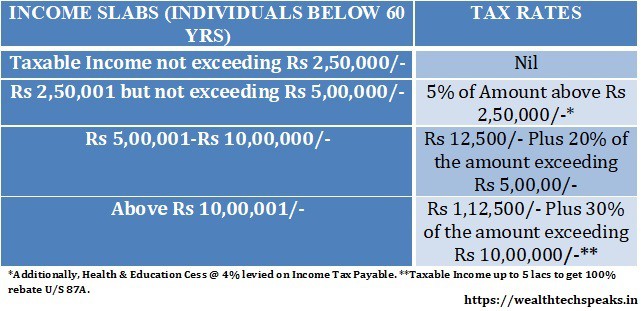
New Tax Regime Slabs for FY 2026-27 (and FY 2025-26)
These are the slabs currently in force for FY 2026-27 (Tax Year 2026-27) — Budget 2026 retained them without change from Budget 2025, so they’re identical to what applied for FY 2025-26:
| Taxable Income Slab | Tax Rate |
| ₹0 – ₹4,00,000 | Nil |
| ₹4,00,001 – ₹8,00,000 | 5% |
| ₹8,00,001 – ₹12,00,000 | 10% |
| ₹12,00,001 – ₹16,00,000 | 15% |
| ₹16,00,001 – ₹20,00,000 | 20% |
| ₹20,00,001 – ₹24,00,000 | 25% |
| Above ₹24,00,000 | 30% |
Worked Examples: Tax With and Without Marginal Relief
The figures below apply to FY 2026-27 — and, since the slabs are unchanged, to FY 2025-26 as well. Assume a resident individual under the new tax regime with taxable income as shown (i.e., after all applicable deductions such as standard deduction, employer NPS contribution, etc.). Cess of 4% is added at the end.
Taxable Income | Slab Tax (No Rebate) | Excess over ₹12L | Marginal Relief | Tax Payable | +4% Cess | Final Tax |
₹12,00,000 | ₹60,000 | — | Full 87A rebate | ₹0 | ₹0 | ₹0 |
₹12,10,000 | ₹61,500 | ₹10,000 | ₹51,500 | ₹10,000 | ₹400 | ₹10,400 |
₹12,25,000 | ₹63,750 | ₹25,000 | ₹38,750 | ₹25,000 | ₹1,000 | ₹26,000 |
₹12,50,000 | ₹67,500 | ₹50,000 | ₹17,500 | ₹50,000 | ₹2,000 | ₹52,000 |
₹12,70,588 | ₹70,588 | ₹70,588 | ≈₹0 (breakeven) | ₹70,588 | ₹2,824 | ₹73,412 |
| ₹12,75,000 | ₹71,250 | ₹75,000 | Not applicable* | ₹71,250 | ₹2,850 | ₹74,100 |
| ₹13,00,000 | ₹75,000 | ₹1,00,000 | Not applicable* | ₹75,000 | ₹3,000 | ₹78,000 |
*Once slab-wise tax on the total income falls below the excess income over ₹12,00,000 — the crossover happens at approximately ₹12,70,588 of taxable income — the taxpayer is already better off under normal slab computation, and marginal relief is no longer relevant.
Detailed Calculation Walkthrough
Numbers make this easier to trust than formulas alone. Here are two full walkthroughs for FY 2026-27 — a simple one to see the mechanics, and a realistic salaried case starting from gross salary.
Example 1: Taxable Income of ₹12,50,000
Step 1 — Tax on total income as per slabs (no rebate):
- ₹0 – ₹4,00,000 → Nil
- ₹4,00,000 – ₹8,00,000 → 5% of ₹4,00,000 = ₹20,000
- ₹8,00,000 – ₹12,00,000 → 10% of ₹4,00,000 = ₹40,000
- ₹12,00,000 – ₹12,50,000 → 15% of ₹50,000 = ₹7,500
- Total tax on ₹12,50,000 = ₹20,000 + ₹40,000 + ₹7,500 = ₹67,500
Step 2 — Excess income over ₹12,00,000: ₹12,50,000 − ₹12,00,000 = ₹50,000
Step 3 — Compare tax to excess income: ₹67,500 (tax) is greater than ₹50,000 (excess income), so marginal relief applies.
Step 4 — Marginal relief: ₹67,500 − ₹50,000 = ₹17,500
Step 5 — Tax payable before cess: ₹67,500 − ₹17,500 = ₹50,000 (this simply equals the excess income)
Step 6 — Add 4% Health & Education Cess: ₹50,000 × 4% = ₹2,000
Final tax payable: ₹50,000 + ₹2,000 = ₹52,000
Without marginal relief, the tax would have been ₹67,500 + 4% cess = ₹70,200. The relief provision saves this taxpayer ₹18,200 in tax.
Example 2: A Salaried Employee with Gross Salary of ₹13,50,000
Step 1 — Compute taxable income from gross salary:
- Gross Salary = ₹13,50,000
- Less: Standard Deduction (Section 16(ia)) = ₹75,000
- Less: Employer’s NPS contribution under Section 80CCD(2) = ₹50,000
- Taxable Income = ₹13,50,000 − ₹75,000 − ₹50,000 = ₹12,25,000
Step 2 — Tax on ₹12,25,000 as per slabs (no rebate):
- ₹0 – ₹4,00,000 → Nil
- ₹4,00,000 – ₹8,00,000 → 5% of ₹4,00,000 = ₹20,000
- ₹8,00,000 – ₹12,00,000 → 10% of ₹4,00,000 = ₹40,000
- ₹12,00,000 – ₹12,25,000 → 15% of ₹25,000 = ₹3,750
- Total tax on ₹12,25,000 = ₹20,000 + ₹40,000 + ₹3,750 = ₹63,750
Step 3 — Excess income over ₹12,00,000: ₹12,25,000 − ₹12,00,000 = ₹25,000
Step 4 — Marginal relief: ₹63,750 − ₹25,000 = ₹38,750
Step 5 — Tax payable before cess: ₹63,750 − ₹38,750 = ₹25,000
Step 6 — Add 4% cess: ₹25,000 × 4% = ₹1,000
Final tax payable: ₹25,000 + ₹1,000 = ₹26,000
Here, a gross salary of ₹13,50,000 — which sounds well clear of the ₹12 lakh ‘zero-tax’ headline — still ends up paying only ₹26,000 in tax, thanks to deductions bringing taxable income down and marginal relief smoothing the rest. Contributing a little more to NPS under Section 80CCD(1B), where room is available, could bring taxable income to ₹12,00,000 or below and eliminate this tax entirely.
The ₹12.75 Lakh Figure Salaried Employees Often Hear About
Many articles state that salaried taxpayers pay zero tax up to a gross salary of ₹12,75,000. This is a different (and equally valid) idea from the marginal relief band above, so it helps to separate the two clearly:
- A salaried employee gets a flat standard deduction of ₹75,000 under the new regime.
- A gross salary of ₹12,75,000 minus ₹75,000 standard deduction gives a taxable income of exactly ₹12,00,000 — which qualifies for the full ₹60,000 rebate under Section 87A, making tax liability nil.
- This is simply the rebate limit applied after the standard deduction — it is not marginal relief. Marginal relief only comes into play once taxable income (after all deductions) itself crosses ₹12,00,000.
You may also see some articles use ₹12.75 lakh as the upper end of the marginal relief band itself (rather than just the salaried zero-tax point above). That’s an approximation — plugging ₹12,75,000 into the same formula gives a slab tax of ₹71,250, which is already less than the ₹75,000 excess income, so marginal relief has nothing left to add at that point. The precise crossover, calculated directly from the slab formula, is ₹12,70,588, as shown in the worked-examples table earlier.
Does Marginal Relief Apply Under the Old Tax Regime?
Marginal relief on the Section 87A rebate itself is generally not extended in the old tax regime once taxable income crosses ₹5,00,000 — the rebate is simply lost beyond that threshold. However, marginal relief for surcharge (relevant to much higher income levels, such as ₹50 lakh, ₹1 crore, ₹2 crore and beyond) is available under both the old and new tax regimes, and works on the same principle: the extra tax due to surcharge cannot exceed the extra income earned.
Who Cannot Claim Marginal Relief Under Section 87A
- Non-resident individuals (NRIs) — the rebate and its relief apply only to resident individuals.
- Hindu Undivided Families (HUFs), firms, companies, and other non-individual assessees.
- Income taxed at special rates, such as short-term capital gains under Section 111A, long-term capital gains under Sections 112/112A, and lottery or online-gaming winnings — the rebate and relief apply only to income taxed at normal slab rates.
Step-by-Step: How to Check If You Qualify
- Compute your total taxable income after all eligible deductions under the new regime (standard deduction, employer NPS contribution under 80CCD(2), etc.).
- If taxable income is ₹12,00,000 or less, your tax is nil (subject to any special-rate income).
- If it is marginally above ₹12,00,000, calculate slab-wise tax on the full amount, then compare it with the excess over ₹12,00,000.
- Apply the lower of the two as your tax before cess, then add 4% cess to get your final liability.
- If reducing your taxable income slightly (through additional NPS contribution under 80CCD(1B), for instance) would bring you back to ₹12,00,000 or below, it may be worth evaluating — since that eliminates tax entirely rather than only claiming marginal relief.
Key Takeaways
- Marginal relief prevents a disproportionate tax outgo when your income just crosses the ₹12,00,000 rebate threshold under the new tax regime.
- The extra tax you pay is capped at the extra income you earned — never more.
- The relief tapers off completely once taxable income reaches approximately ₹12,70,588; beyond this, normal slab tax applies without any relief.
- It does not extend to special-rate incomes like capital gains, and it is not available to NRIs, HUFs, or non-individual taxpayers.
- Understanding this provision helps you plan deductions (like additional NPS investment) to either stay within the nil-tax zone or make an informed decision about the small marginal-relief tax band.
- For the year you’re in right now — FY 2026-27 — this provision is technically Section 156 of the new Income Tax Act, 2025 (in force from 1 April 2026), and ‘FY 2026-27’ is formally ‘Tax Year 2026-27’; the rebate amount and marginal relief mechanics themselves are unchanged.
Wealthtech Speaks or any of its authors are not responsible for any errors or omissions, accuracy, completeness, timeliness or for the results obtained from the use of this information. This article is for informational purpose only. Readers are advised to research further to have detailed knowledge on the topic. It is very important to do your own analysis and consult your Financial Advisor before arriving at any conclusion.
Categories
- All About Mutual Funds (20)
- Annual Budget (14)
- Banner (6)
- Bonus Act (1)
- Economic Trends (38)
- Economy (52)
- Employee Deposit Linked Insurance Scheme (EDLI) (1)
- Employees’ Benefits (37)
- Employees’ Pension Scheme (EPS) (11)
- Employees’ Provident Fund (EPF) (13)
- Employees’ State Insurance (ESI) (4)
- Equity Linked Savings Scheme (ELSS) (12)
- Gadgets Review (70)
- Gratuity Act (4)
- Health Insurance (10)
- Home Loans (5)
- HR Talks (6)
- Human Resource (18)
- Income Tax (70)
- Indirect Tax (1)
- Insurance (28)
- Investment Plans (55)
- Investments (74)
- Life Insurance (22)
- Loans (6)
- Mutual Funds (30)
- Other HR Laws (7)
- Personal Loans (4)
- Portfolio Management (14)
- Portfolio Management (7)
- Professional Tax (9)
- Retirement Benefits (14)
- Retirement Plans (22)
- SidebarAd (1)
- Statutory Benefits (19)
- Systematic Investment Plan (SIP) (7)
- Tax Planning (41)
- Taxation (78)
- Tech News (22)
- Technology (81)
- Wages Act (3)
- Wealth Speaks...!!! (68)