UPI Transaction Charges 2026: New MDR Rules Explained
- Posted By Amritesh
- On October 3rd, 2026
- Comments: no responses
The Headline, Cleared Up First
If your feed is suddenly full of “UPI to be charged” posts, take a breath. Person-to-person (P2P) UPI transfers — the ₹500 you send a friend, the rent you pay your landlord, the money you move between your own accounts — remain completely free. What is changing is a Merchant Discount Rate (MDR) on a specific slice of person-to-merchant (P2M) payments, and it is the merchant, not you, who is billed for it.
The Ministry of Finance issued the enabling gazette notification on 14 September 2026, NPCI followed with its official circular and FAQ document on 15 September 2026, and the framework takes effect on 15 October 2026. Here is exactly what it covers.
What’s Actually Changing
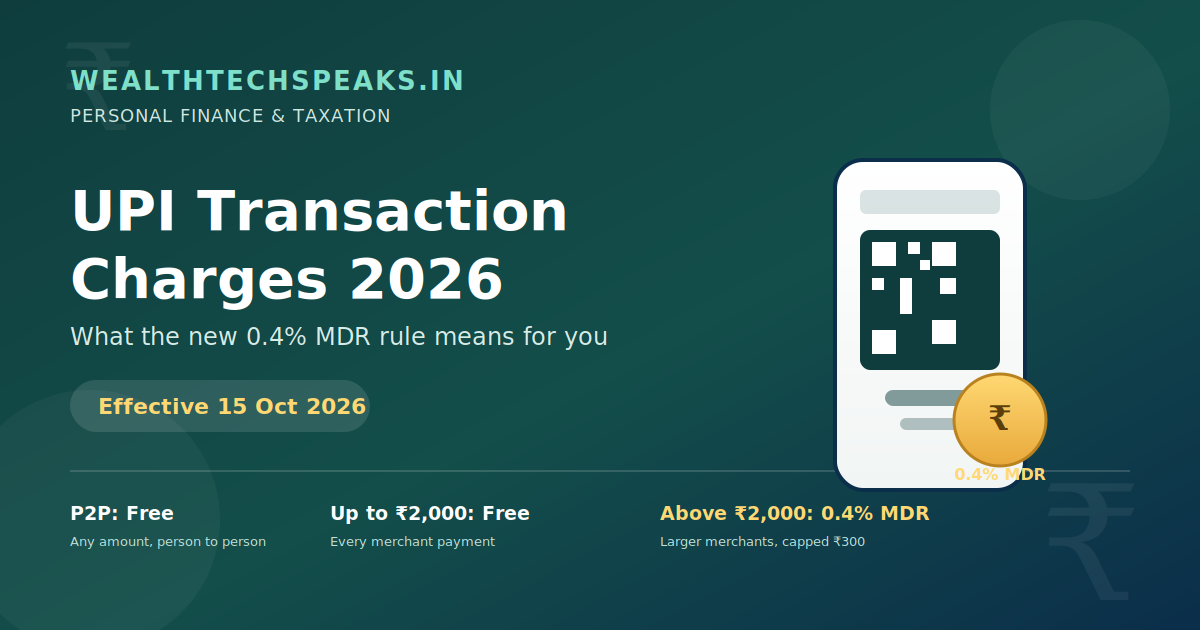
- A 0.4% MDR applies to person-to-merchant (P2M) UPI payments above ₹2,000.
- The fee is capped at ₹300 per transaction, which kicks in around the ₹75,000 mark.
- Payments of ₹2,000 or less carry zero MDR, regardless of who you’re paying.
- Small and micro-merchants receiving up to roughly ₹1 lakh a month via UPI QR stay exempt.
- Person-to-person transfers, of any amount, remain outside the MDR framework entirely.
- Railways, telecom, insurance, fuel and farm-input payments above ₹2,000 attract a flat ₹5 MDR instead of the 0.4% rate, and utility and education payments above ₹2,000 follow their own specified structure. Capital-market transactions (mutual funds, stockbrokers, securities) carry a separate 0.02% MDR, also capped at ₹300.
In rupee terms, on an eligible transaction: a ₹5,000 UPI payment attracts about ₹20 in MDR, a ₹10,000 payment about ₹40, a ₹25,000 payment about ₹100, and anything from ₹75,000 upward is capped at ₹300 — however large the bill.
Who Pays: A Quick Comparison
| Transaction Type | MDR Applies? | Who Bears the Cost |
| P2P transfer (any amount) | No | — (free) |
| P2M payment ≤ ₹2,000 | No | — (free) |
| P2M payment > ₹2,000, small/micro-merchant | No (exempt) | — (free) |
| P2M payment > ₹2,000, larger merchant | Yes — 0.4%, capped ₹300 | Merchant (shared with banks/PSPs) |
So Does This Touch “Normal People” at All?
Directly: no. The rule is explicit that no transaction fee or platform fee can be charged to the person paying, and banks have been directed to ensure merchants don’t pass the MDR on to customers as a separate line item. By volume, roughly 95–96% of UPI merchant transactions fall at or under ₹2,000 and stay untouched, on top of every P2P transfer at any value. By rupee value the exempted share is smaller — government figures put it at around 70% of total UPI transaction value — since a minority of larger-ticket payments accounts for a disproportionate share of the money moved. Either way, for the ordinary run of daily spends, nothing changes for the customer.
Indirectly, three effects are worth watching:
- Pricing creep: A large retailer absorbing a 0.4% cost on high-ticket sales may quietly build it into MSPs or “digital payment” surcharges over time, the way some businesses already do with card payments — even though this is discouraged for UPI specifically.
- Payment-method nudges: Some bigger merchants may start nudging big-ticket buyers toward cash, cards, or net banking for large purchases to sidestep the fee, or may split large bills to stay under thresholds where allowed.
- Cash concerns among traders: Several merchant associations have flagged a risk that big-ticket QR payments could quietly shift back to cash, which would matter for anyone used to a fully digital trail for large purchases, EMIs, or big-ticket retail.
Early signs since the announcement: NPCI data shows UPI volumes dipped 1.8% in September 2026 to 24.07 billion transactions, down from August’s record 24.51 billion, amid trader unease over the looming MDR — even as average daily payment value hit a fresh high. Separately, merchant and trader bodies challenged the framework in the Supreme Court; on 28 September 2026 the Court declined to grant an interim stay, so the 15 October rollout is proceeding as scheduled.
None of this is guaranteed — regulators have explicitly barred passing the charge on — but it’s the practical grey zone to watch over the next couple of billing cycles.
Why the Government Introduced ‘UPI Transaction Charges’?
UPI has run on a zero-MDR model for merchant payments since January 2020, funded instead through government incentive schemes to banks and PSPs. With UPI now processing over 24 billion transactions worth close to ₹30 lakh crore a month, that subsidy model has become expensive to sustain. NPCI and the finance ministry have framed the new MDR as a way to fund infrastructure, fraud prevention, and customer service investment on the higher-value, more commercially significant end of the merchant side — while explicitly ring-fencing everyday consumer use and small-merchant acceptance from any cost. Estimates put the potential ecosystem revenue from this slice of transactions at up to roughly ₹16,000 crore a year.
What This Means for Small Businesses?
If you run a shop, clinic, salon, or service business and your monthly UPI QR collections stay within the small/micro-merchant exemption band, this change shouldn’t touch you. If your ticket sizes regularly cross ₹2,000 and your turnover puts you outside that exemption, budget for a small, capped cost of doing business — comparable to, and still meaningfully cheaper than, the 1–3% merchants typically pay on credit cards or the ~0.8–0.9% on debit cards. It’s worth checking with your payment aggregator or bank directly once the framework goes live, since the exact merchant categorisation and any early-bird relief will be decided by NPCI’s steering committee rather than being identical for every business type.
What You Should Actually Do Before 15th October 2026
- Nothing changes in how you use UPI for daily spends, bill splits, or sending money to people — no action needed there.
- If you run a business, check with your bank or payment aggregator whether your average ticket size and monthly volume put you inside or outside the small-merchant exemption.
- Watch your bills for the next few months for any new “digital payment” or “UPI processing” line item on high-value purchases — this shouldn’t be charged to you, and you can flag it to the merchant or your bank if it appears.
- Ignore forwarded messages claiming a flat “UPI tax” on all transactions — that characterisation is inaccurate; this is a merchant-side MDR on a narrow band of transactions, not a universal fee.
- For anything transaction-critical — a large EMI, a big purchase near a billing cycle — keep an eye on official NPCI, RBI, or bank communications rather than social media summaries, since exact merchant slabs may still be refined before go-live.
The Bottom Line
UPI is not becoming a paid service for consumers. What’s arriving on 15 October 2026 is a modest, capped fee on the merchant side of higher-value UPI payments — designed to fund the ecosystem without touching the P2P transfers and small daily purchases that make up the overwhelming majority of UPI’s volume. The one thing worth actually tracking as an ordinary user is whether that cost quietly finds its way into prices or surcharges over time, since that’s the one channel through which it could eventually reach your wallet.
Disclosures & Citations: Ministry of Finance gazette notification dated 14 September 2026; NPCI official circular and MDR FAQ document dated 15 September 2026; Supreme Court order of 28 September 2026 declining an interim stay; NPCI transaction-volume data for September 2026; reporting from Business Standard, Business Today, Inc42, The South First and Deccan Chronicle. Figures reflect the framework as announced ahead of the 15 October 2026 effective date and may be refined by NPCI’s steering committee before go-live — verify current terms with NPCI, RBI, or your bank before making business decisions.
Frequently Asked Questions
Q1. Will I be charged anything when I pay a friend or family member on UPI?
No. Person-to-person (P2P) UPI transfers remain completely free, regardless of the amount sent, and this is unaffected by the 15 October 2026 change.
Q2. I paid a shop ₹5,000 by UPI. Will ₹20 be deducted from my account?
No. Nothing is deducted from the payer’s account. The 0.4% MDR (₹20 on ₹5,000) is charged within the merchant payment ecosystem — it is settled between the merchant, its bank, and the payment app, not from your account.
Q3. Is this a new government tax on UPI?
No. MDR is a private ecosystem fee shared among banks, payment service providers and UPI app providers — not a tax collected by the government. NPCI has explicitly clarified this.
Q4. Does the ₹2,000 threshold mean I can’t send more than ₹2,000 on UPI?
No. ₹2,000 is not a transaction or daily limit — standard UPI limits (₹1 lakh/day for P2P, higher for categories like tax, health and education) are unchanged. ₹2,000 is only the threshold above which a merchant payment may attract MDR.
Q5. Will small shopkeepers, kirana stores, or vegetable vendors have to pay this fee?
Small and micro-merchants receiving up to roughly ₹1 lakh a month via UPI QR are exempt from the MDR. The fee is aimed at larger, higher-turnover merchants.
Q6. Can a merchant add a “UPI charge” or “digital payment surcharge” to my bill because of this?
They’re not supposed to. Banks have been directed to ensure merchants don’t pass the MDR on to customers as a separate charge, and UPI app providers are barred from adding platform fees. If you spot such a line item, you can flag it to the merchant or your bank.
Q7. Does this affect SIP payments, insurance premiums, or bill payments via UPI AutoPay?
UPI AutoPay transactions used for recurring payments such as SIPs remain free of the new MDR. Some categories like railways, telecom, insurance, fuel and utilities have their own lower, flat MDR structures rather than the standard 0.4%.
Q8. What about UPI payments for mutual funds or stock market transactions?
Capital market transactions (mutual funds, securities, stockbrokers, dealers) attract a much lower MDR of 0.02%, capped at ₹300 — not the standard 0.4% rate.
Q9. Is there a maximum fee a merchant will ever pay, no matter how large the transaction?
Yes. The MDR is capped at ₹300 per transaction, a ceiling that applies from around ₹75,000 upward — so a ₹2 lakh UPI payment attracts the same ₹300 cap as a ₹75,000 one.
Q10. From when exactly does this apply?
The framework takes effect on 15 October 2026. Transactions before that date are unaffected.
Q11. Where can I check the official rules if I run a business?
Refer to NPCI’s UPI MDR FAQ document and official Ministry of Finance notifications, or check directly with your bank or payment aggregator, since exact merchant categorisation may be refined before go-live.
Q12. Has this been challenged in court, or could it still be delayed?
Merchant and trader associations challenged the new MDR framework, but on 28 September 2026 the Supreme Court declined to grant an interim stay. Barring a further court order, the framework proceeds as scheduled on 15 October 2026.
Wealthtech Speaks or any of its authors are not responsible for any errors or omissions, accuracy, completeness, timeliness or for the results obtained from the use of this information. This article is for informational purpose only. Readers are advised to research further to have detailed knowledge on the topic. It is very important to do your own analysis and consult your Financial Advisor before arriving at any conclusion.
Categories
- All About Mutual Funds (20)
- Annual Budget (14)
- Banner (6)
- Bonus Act (1)
- Economic Trends (38)
- Economy (52)
- Employee Deposit Linked Insurance Scheme (EDLI) (1)
- Employees’ Benefits (37)
- Employees’ Pension Scheme (EPS) (11)
- Employees’ Provident Fund (EPF) (13)
- Employees’ State Insurance (ESI) (4)
- Equity Linked Savings Scheme (ELSS) (12)
- Gadgets Review (70)
- Gratuity Act (4)
- Health Insurance (10)
- Home Loans (5)
- HR Talks (6)
- Human Resource (18)
- Income Tax (70)
- Indirect Tax (1)
- Insurance (28)
- Investment Plans (55)
- Investments (74)
- Life Insurance (22)
- Loans (6)
- Mutual Funds (30)
- Other HR Laws (7)
- Personal Loans (4)
- Portfolio Management (14)
- Portfolio Management (7)
- Professional Tax (9)
- Retirement Benefits (14)
- Retirement Plans (22)
- SidebarAd (1)
- Statutory Benefits (19)
- Systematic Investment Plan (SIP) (7)
- Tax Planning (41)
- Taxation (78)
- Tech News (22)
- Technology (81)
- Wages Act (3)
- Wealth Speaks...!!! (68)