Rising Gadget Prices, Smarter Payments: A 2026 Guide for Indian Buyers
- Posted By Amritesh
- On November 2nd, 2026
- Comments: no responses
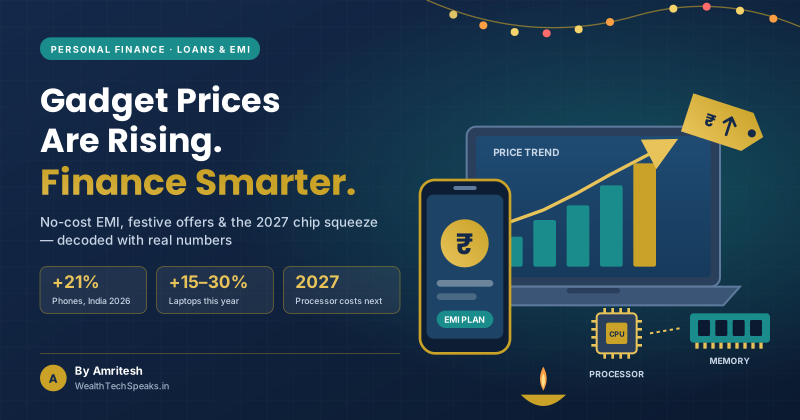
If you have shopped for a phone or laptop recently, you have probably noticed something unusual: prices are going up, not down. For most of the last decade, the rule of thumb was simple — wait a few months and the same gadget gets cheaper. In 2026, that rule has broken.
Smartphones and laptops have become a necessity for work, studies, banking and staying connected, so most of us cannot simply stop buying them. The real question is how to pay for them without quietly damaging your finances. This guide explains why prices are rising (and why processor costs may push them up again in early 2027), what the festive season really offers this year, decodes every financing option you will be offered at the checkout, and runs the actual numbers so you can choose wisely.
Why gadget prices are rising — and why it may not reverse soon
The main culprit is the humble memory chip. The global race to build artificial-intelligence data centres has created enormous demand for high-bandwidth memory. Memory makers such as Samsung, SK hynix and Micron earn far higher margins on those chips, so they have shifted factory capacity away from the ordinary DRAM and NAND flash that go into phones and laptops. The result is a shortage of everyday memory, and memory has now become one of the most expensive parts inside a smartphone.
Here is what the data shows for India in 2026:
| Indicator | What the data says |
| Average smartphone price in India (2026 YTD) | Up about 21% versus last year — higher than the ~15% global rise (Counterpoint Research, Sep 2026) |
| Budget phones (below ₹10,000) | Average prices up 17.6% in Jan–May 2026 |
| Laptops (Dell, HP, Lenovo etc.) | Reported increases of 15%–30% this year |
| Memory cost of a typical 8GB + 256GB phone | Roughly $35 in Q3 2025 to an estimated $144 by Q4 2026 (Omdia estimates) |
| Processor (chip) prices | Intel and Qualcomm PC chips reportedly up ~10–20% in Sep–Oct 2026; TSMC reportedly plans 5–10% higher manufacturing prices for 2027 |
| Smartphones bought on EMI / finance | Expected to reach 42% of all sales in 2026, up from 35% in 2025 |
| Refurbished smartphone volumes | Up 13% in H1 2026 while new phone volumes fell about 11% |
What about the future? Industry trackers like IDC, Gartner and Omdia expect memory prices to stay elevated at least through the first half of 2027, and possibly to the end of 2027. Meaningful relief is linked to new factory capacity coming online around 2028. Add a weaker rupee and freight disruptions, and the honest conclusion is: do not plan your next purchase on the assumption that prices will fall soon.
The second wave: processors are getting costlier too
Memory was the first shock. The processor — the “brain” of every phone and laptop — looks set to be the second. The same AI boom is filling up the world’s most advanced chip factories, and chipmakers have started passing higher costs on. Reports from the PC supply chain suggest Intel raised prices on several laptop processor families by roughly 10–20% around September–October 2026, and Qualcomm’s Snapdragon X series PC chips reportedly went up about 10% from 1 October. AMD is expected to follow.
More importantly, TSMC — which manufactures chips for Apple, Qualcomm, MediaTek, AMD and many others — is reported to be planning price increases of about 5–10% on advanced chip production from early 2027, with smaller hikes on older nodes and a steeper premium on advanced packaging. Intel is also reported to be lining up a roughly 10% increase around its major product launch expected in March 2027. These reports come from supply-chain sources and are not official announcements, but the direction is clear: phones and laptops launching in the first half of 2027 will carry both the memory cost and a fresh processor cost. That is why waiting for prices to “settle” next year may simply mean paying more.
There is one more twist. On 7 October 2026, the RBI raised the repo rate by 25 basis points to 5.50% — its first hike since February 2023 — and changed its stance to “calibrated tightening”. Borrowing is not going to get cheaper in the near term either. That makes it even more important to understand what each financing option truly costs.
The new math: buy now, or wait and save?
In a world of falling prices, saving first and buying later was the obvious winner. In a world of rising prices, the answer depends on two numbers: how fast the price is rising, and how much the financing costs you.
Example: You need a laptop that costs ₹57,500 today (cash price). You can save ₹5,000 a month in a recurring deposit or liquid fund earning about 6.5% a year. After 12 months, your corpus will be roughly ₹62,150. But what will the laptop cost then?
| If prices rise by… | Laptop price after 1 year | Your savings corpus | Shortfall / (surplus) |
| 10% | ₹63,250 | ₹62,155 | ₹1,095 short |
| 15% | ₹66,125 | ₹62,155 | ₹3,970 short |
| 20% | ₹69,000 | ₹62,155 | ₹6,845 short |
You also live without the device for a year, which may hurt your work or studies. Compare this with the true cost of a well-chosen no-cost EMI (about ₹3,500 — see below). When prices are rising 15–20% a year, low-cost financing for a device you genuinely need can actually beat waiting. The key words are “low-cost” and “genuinely need” — the rest of this guide is about making sure both are true.
Festive season 2026: a good time to buy, but not like before
Navratri, Dussehra and Diwali have traditionally been the best time of the year to buy a phone or laptop in India. Big online sales, bank cashbacks and showroom offers made deep price cuts the norm. This year, the festive season looks different — and smart buyers should adjust their strategy.
- Fewer straight price cuts, more “financing offers”: With component costs up sharply, brands and retailers have far less room for discounts. Large retail chains have indicated that outright price cuts on smartphones will be fewer than last year, and offers are shifting towards no-cost EMI, longer tenures, bank cashback and exchange bonuses.
- EMI is the festive hook: During Amazon’s Prime Day 2026, about one in four electronics purchases were made on EMI — and four out of five of those used no-cost EMI. Expect the festive pitch to be “low monthly payment” rather than “low price”.
- Prices are already higher before the discount: Some popular models now cost 50–90% more than their predecessors launched a year earlier. A “festive discount” on an already-raised price can still leave you paying more than last year’s regular price.
- The window may be short: Industry players expect another round of price increases after the festive quarter, and with processor costs also rising in early 2027, the festive season may be the last relatively good buying window for a while.
How to make the most of festive offers:
- Fix your budget and model before the sale. Track the price for a few weeks so you can spot a genuine deal versus an inflated “MRP” with a discount sticker.
- Compare the full-payment price with the EMI price. Many festive offers give 10% cashback on full payment or UPI — choose no-cost EMI and you may lose it. Use the worked example below to find your true cost.
- Treat exchange bonuses and buyback plans as real money, but check the conditions. An assured buyback is useful only if you will actually return the device on time and in the required condition.
- Do not let a long tenure lure you into a bigger phone. Festive schemes now stretch to 15–18 months or more. A lower EMI on a costlier model is still a bigger loan.
- Buy only what you were going to buy anyway. If your current device works well, a festive sale alone is not a reason to upgrade — but if you need one in the next 6–9 months, buying now is likely better than waiting for 2027 prices.
Every financing option, decoded
1. No-cost EMI (credit card or debit card)
This is the most popular option on Amazon, Flipkart and brand stores. Here is the secret: the bank still charges interest. The seller or brand simply gives you an upfront discount equal to that interest, so your EMIs add up to the product price. It is not free in three ways:
- GST on the interest: 18% GST is levied on the interest component that the bank charges, and it is billed to you on your card statement — even though you never “see” the interest.
- Processing fee: Banks typically charge ₹99–₹999 plus 18% GST to convert a purchase to EMI.
- Lost discounts: Often the biggest hidden cost. Many instant discounts, cashback or a lower price apply only if you pay in full; choose no-cost EMI and you give them up.
2. Regular credit card EMI
You convert the purchase into EMIs at the bank’s interest rate (commonly in the mid-teens per year), plus processing fee and GST on both. It is transparent, but costlier than a well-structured no-cost EMI. RBI rules require card issuers to clearly disclose the interest component and processing fee at the time of EMI conversion, so always read that screen.
3. NBFC consumer durable loan (in-store “zero interest” schemes)
Offered by NBFCs at mobile and electronics stores — they account for roughly two-thirds of financed smartphone purchases in India. They are easy to get, even without a credit card. But many “zero-interest” schemes come with a hefty processing fee and advance EMIs (for example, 10 EMIs of which 2 are paid upfront). Paying EMIs in advance means you are borrowing less money for the same fee, which pushes up the effective interest rate sharply — as the worked example below shows.
4. Personal loan
Makes sense only for large purchases or when you are buying several devices together. Watch the processing fee (often 1–3% plus GST) and remember the RBI’s October hike may nudge floating rates up.
5. Buy Now, Pay Later (BNPL) and pay-later wallets
Convenient for small amounts and short periods, but late fees can be steep and every BNPL account is a credit line that shows up on your credit report. Stacking multiple BNPL plans is one of the fastest ways to lose track of your obligations.
6. Swiping the credit card and paying the “minimum due”
This is not financing — it is the most expensive debt most Indians will ever take. Revolving credit card interest typically runs 3–3.75% a month (about 36–45% a year) plus GST, and you lose your interest-free period on new purchases too.
Worked example: what a ₹57,500 laptop really costs
Let us compare the options side by side for the same laptop over roughly 12 months.
| Assumptions used Cash price (full payment via UPI/debit): ₹57,500. Price on no-cost EMI and NBFC scheme: ₹60,000 (₹2,500 full-payment discount forgone). No-cost EMI: 12 months, bank rate 15% p.a. (offset by seller discount), 18% GST on interest, processing fee ₹199 + GST. Card EMI: 16% p.a. on ₹57,500, 12 months, fee ₹199 + GST, GST on interest. Personal loan: 14% p.a., 12 months, 2% fee + GST. NBFC scheme: 10 EMIs of ₹6,000 with 2 paid in advance, processing fee ₹1,199 + GST. Revolving card: 3.5% per month + GST, paying ₹5,000 a month. Effective annual rate = the true yearly interest rate implied by all the cash flows, compared with paying ₹57,500 upfront. |
| Option | Total you pay | Extra over cash price | Effective annual cost |
| Pay in full (cash price) | ₹57,500 | — | — (only lost interest on savings) |
| No-cost EMI, 12 months | ₹61,063 | ₹3,563 | ≈ 11.9% |
| NBFC “zero-interest” 10/2 scheme | ₹61,415 | ₹3,915 | ≈ 25.8% |
| Personal loan @ 14% | ₹63,310 | ₹5,810 | ≈ 20.2% |
| Credit card EMI @ 16% | ₹63,758 | ₹6,258 | ≈ 21.5% |
| Revolving credit card (minimum-due style) | ₹79,605 over 16 months | ₹22,105 | ≈ 50%+ |
Three lessons stand out. First, “no-cost” EMI is not free — here it cost about ₹3,500, mostly because of the forgone full-payment discount. If there is no such discount, its cost falls to roughly ₹1,000 (just GST and the fee). Second, the in-store “zero-interest” scheme looks cheap in rupees, but advance EMIs make its effective rate more than double that of the no-cost EMI. Third, revolving credit card debt is in a different league altogether — avoid it completely.
Note: Numbers are illustrative; actual fees, rates and discounts vary by bank, NBFC, seller and offer. Always do this comparison with the offer in front of you.
Seven rules of smart gadget financing
- Compare the total payable, not the EMI. A small EMI over 24 or 30 months can hide a large total cost. Brands now offer EMIs stretching up to 30 months — that is longer than many people keep a phone.
- Ask for the full-payment price before choosing EMI. If paying in full gets a discount, the no-cost EMI is costing you exactly that discount plus fees.
- Keep tenure shorter than the device’s useful life. Never be paying for a phone you have already replaced. As a rule of thumb, finance a phone for 6–12 months and a laptop for no more than 12–18 months.
- Cap gadget EMIs at about 5% of take-home pay. Your total EMIs (home, car, everything) should ideally stay under 35–40% of take-home pay. Gadgets are depreciating assets; they should take a small slice.
- Never stack plans. One active gadget EMI at a time. Multiple EMIs and BNPL lines increase the risk of a missed payment and can pull down your credit score.
- Automate every EMI. Set up auto-debit or standing instructions. A single missed EMI on a card can trigger late fees, interest on the full amount and a hit to your CIBIL score.
- Read the conversion screen. Check interest component, processing fee, GST, foreclosure charges and whether advance EMIs are required. If the store staff cannot show you the total payable in writing, walk away.
Reduce how much you need to finance
The cheapest loan is the one you do not need. Before choosing an EMI, try to shrink the amount itself:
- Use exchange and trade-in offers: Your old phone or laptop has real value. Compare the store’s exchange price with what refurbishers and resale platforms offer.
- Consider certified refurbished devices: Buyers are moving here fast — refurbished phone volumes in India grew 13% in H1 2026 and are expected to rise 16% for the year. Buy only from organised sellers or brand programmes that offer a warranty, invoice and return policy.
- Buy the previous generation: Last year’s flagship often delivers 90% of the experience at a much lower price, and was manufactured before the steepest memory cost increases.
- Right-size the specification: Memory and storage are now the costliest components. Buy the storage you really need (use cloud backup for photos) — but do not under-buy RAM on a laptop you plan to keep for 4–5 years, especially for AI-ready software.
- Stack legitimate offers: Bank instant discounts, card cashback, brand loyalty programmes and festive sales can add up — but only count offers that apply to your chosen payment mode.
- Think twice about add-ons: Extended warranties and protection plans are financed too if bundled into the EMI. Buy them only if the cost is reasonable relative to repair costs.
The tax and employer angle (often ignored)
- Salaried employees: Check your company’s device policy. Many employers provide a laptop or phone, or reimburse a device used for official work. A laptop or computer provided by the employer is generally a tax-free perquisite under the income-tax perquisite valuation rules, so a company-provided device can be far cheaper than buying one yourself. Some employers also run device-leasing programmes through salary — compare the total cost carefully.
- Freelancers and professionals: A laptop or phone used for your profession is a business asset. You may claim depreciation on it, and if you are GST-registered, you may be able to claim input tax credit on the 18% GST paid — subject to the applicable rules. Keep the invoice in your business’s name. (Note that from 1 April 2026, the Income-tax Act, 2025 has renumbered many provisions; consult your tax advisor for the current section references.)
- Everyone: GST on smartphones remains 18%, and it is charged on the full price whether you pay in cash or EMI — there is no tax advantage to financing.
Build a “gadget sinking fund” for your next upgrade
The smartest long-term strategy is to stop needing loans for gadgets at all. The day you buy a device, start a small monthly SIP or recurring deposit for its replacement. For example, if your phone costs ₹40,000 and you replace it every three years, about ₹1,150–1,350 a month in a low-risk option such as a liquid fund or RD (assuming 10–15% yearly price rises and about 6.5% returns), together with ₹8,000 or so from trading in the old phone, can fund the next one. Do this, and your next upgrade becomes a cash purchase — with every full-payment discount available to you.
Since gadget prices are rising faster than general inflation right now, build in a cushion: assume your next device will cost 15–20% more than the current one.
Frequently asked questions
Is no-cost EMI really free?
No. The bank charges interest, which is offset by a seller discount, but you usually pay 18% GST on that interest, a processing fee, and you may lose full-payment discounts. It is often the cheapest form of financing, but not free.
Will smartphone and laptop prices fall in 2027?
Industry analysts expect memory prices to stay elevated at least through the first half of 2027, so a sharp fall is unlikely in the near term. On top of that, processor manufacturing costs are reported to rise from early 2027. Relief is more likely once new memory factories come online around 2028.
Does buying on EMI affect my credit score?
Yes. A card EMI or consumer durable loan is reported to credit bureaus. Paying on time can help build your history; missing payments or having too many active credit lines can hurt it.
Which is better — NBFC store finance or credit card no-cost EMI?
If you have a credit card and a genuine no-cost EMI offer, it is usually cheaper. NBFC schemes are useful if you do not have a card, but check the processing fee and advance EMIs, which can make the effective rate much higher.
Are festive season 2026 offers worth it?
They can be, but expect fewer direct price cuts and more EMI, cashback and exchange offers. If you need a device in the next few months, a festive deal is likely better than waiting, since prices are expected to rise again after the festive quarter and processor costs are set to climb in early 2027. Always compare the full-payment price with the EMI price.
The bottom line
Rising gadget prices are not a reason to panic or to take on careless debt. They are a reason to be more deliberate. Buy what you genuinely need, shrink the amount through trade-ins, refurbished options or the previous generation, and if you must finance, choose the option with the lowest total cost and the shortest sensible tenure. Then start saving for your next upgrade the day this one arrives. That is smart financing — and it works whether prices go up or down.
Disclaimer: This article is for educational purposes only and is not personalised financial, tax or credit advice. Interest rates, fees, offers and tax rules change and vary by lender and individual circumstances. Please verify the current terms with your bank, NBFC or a qualified advisor before making a decision.
Categories
- All About Mutual Funds (20)
- Annual Budget (14)
- Banner (6)
- Bonus Act (1)
- Economic Trends (38)
- Economy (52)
- Employee Deposit Linked Insurance Scheme (EDLI) (1)
- Employees’ Benefits (37)
- Employees’ Pension Scheme (EPS) (11)
- Employees’ Provident Fund (EPF) (13)
- Employees’ State Insurance (ESI) (4)
- Equity Linked Savings Scheme (ELSS) (12)
- Gadgets Review (70)
- Gratuity Act (4)
- Health Insurance (10)
- Home Loans (5)
- HR Talks (6)
- Human Resource (18)
- Income Tax (70)
- Indirect Tax (1)
- Insurance (28)
- Investment Plans (55)
- Investments (74)
- Life Insurance (22)
- Loans (6)
- Mutual Funds (30)
- Other HR Laws (7)
- Personal Loans (4)
- Portfolio Management (14)
- Portfolio Management (7)
- Professional Tax (9)
- Retirement Benefits (14)
- Retirement Plans (22)
- SidebarAd (1)
- Statutory Benefits (19)
- Systematic Investment Plan (SIP) (7)
- Tax Planning (41)
- Taxation (78)
- Tech News (23)
- Technology (82)
- Wages Act (3)
- Wealth Speaks...!!! (69)