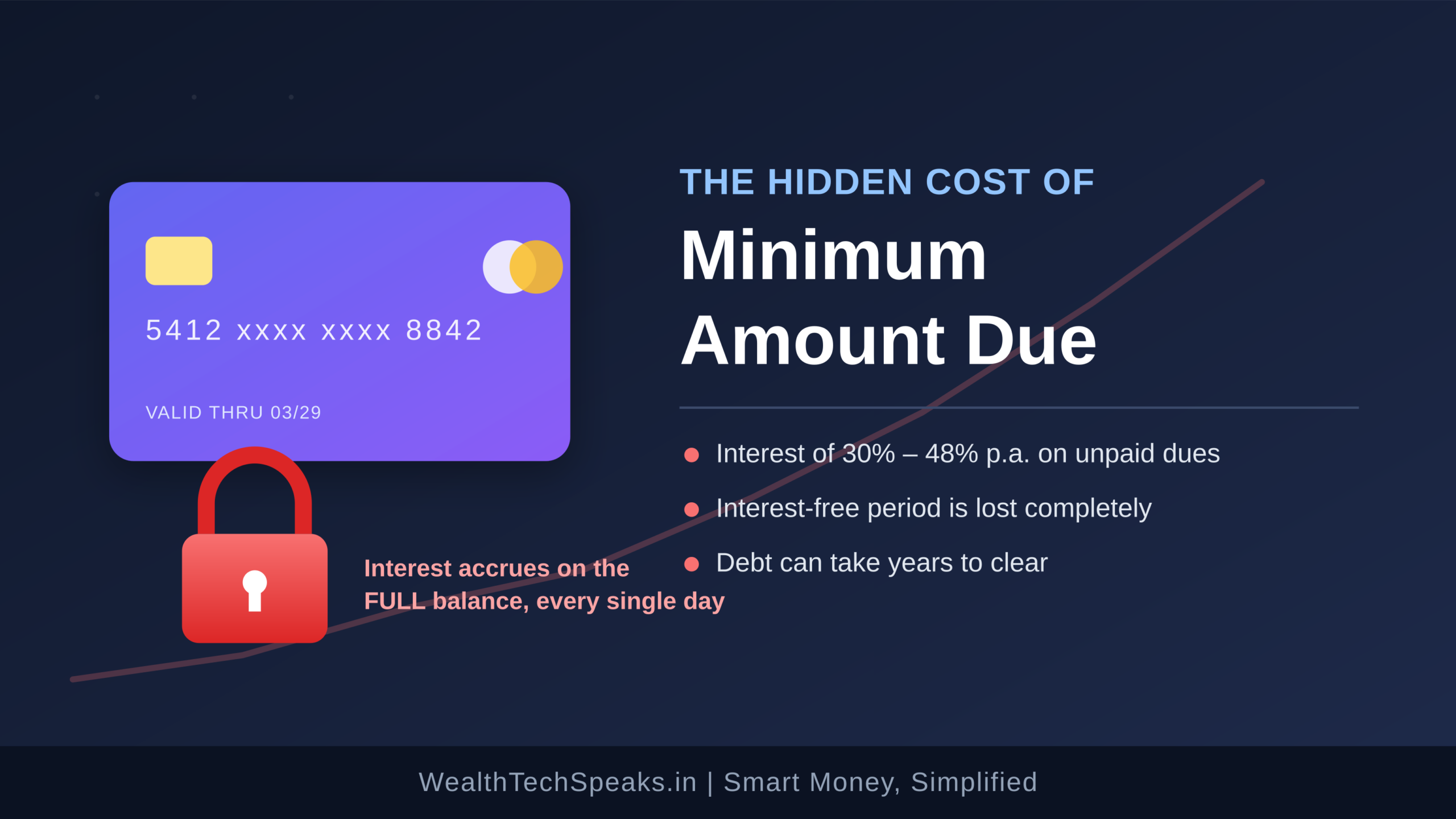
Minimum Amount Due (MAD) on Credit Card: Trap & Avoidance
- Posted By Amritesh
- On August 10th, 2026
- Comments: no responses
A complete guide to the minimum amount due credit card meaning, how MAD is calculated, why it feels safe, and how it can quietly cost you lakhs in interest — for the Indian credit card user.
The minimum amount due on a credit card is the smallest sum your bank will accept each month without charging a late fee or reporting you as overdue. Every month, your credit card statement shows two numbers: the Total Amount Due, and this much smaller figure called the Minimum Amount Due (MAD). Paying just the MAD keeps your account technically “in good standing.” It feels like a safety net. In reality, it is one of the most expensive habits an Indian cardholder can fall into, and banks are in no hurry to explain why. This guide covers what MAD is, how it is calculated, the real credit card interest rate in India, and how to avoid the debt trap for good.
| Quick Summary Minimum amount due is roughly 5% of your outstanding bill. Paying only this avoids late fees and a default flag — but not interest. Indian credit card interest rates run 30-48% p.a., charged on the full balance, and your interest-free period disappears until you clear the entire dues. Always aim to pay the Total Amount Due in full. |
Minimum Due Credit Card Meaning: What Is MAD?
The minimum due credit card meaning is simple: it’s the smallest sum you must pay by the due date to avoid a late payment fee and to keep your card from being reported as “overdue” or delinquent to the credit bureaus. It does not mean you owe less — it only changes how little of your bill you can get away with paying that month.
In India, MAD is typically calculated as the higher of a small fixed floor amount and a percentage of your outstanding bill, made up of:
- Around 5% of the total outstanding principal (this varies slightly bank to bank)
- 100% of any EMI instalments due that month
- 100% of any over-limit amount, if you have exceeded your credit limit
- GST and applicable fees/charges on the bill
- Unpaid minimum due (if any) carried over from the previous cycle
Several banks revised their MAD formulas in 2026 to also factor in the full finance charge component when interest and fees are high — meaning if you are already carrying a large balance, your minimum due itself can climb sharply month on month, not just your interest.
What Paying Minimum Due on a Credit Card Actually Helps You Avoid
To be fair to MAD, it does serve a real purpose. Paying it on time helps you avoid:
- Late payment fee — this can range from roughly ₹100 to over ₹1,000+ depending on the outstanding slab
- Your account being marked as “defaulted” or delinquent with the credit bureaus
- An immediate drop in your credit score from a missed payment
- Possible restriction or suspension of your card by the issuer
That is the entire list. Notice what is missing: interest. Paying the minimum due does nothing to protect you from interest charges — and that is exactly where the trap lies.
Credit Card Interest Rate in India: The Real Cost of MAD
This is the part most cardholders underestimate. Credit card interest in India is among the steepest of any retail borrowing product, typically ranging from about 2.5% to 3.75% per month, which works out to roughly 30% to 45% per annum depending on the issuer and card variant.
| Component | Typical Range in India |
| Monthly interest (finance charge) | 2.5% – 3.75% per month |
| Annualised interest rate | ~30% – 48% per annum |
| Minimum Amount Due | ~5% of outstanding + EMIs + over-limit + GST |
| Late payment fee | ₹100 – ₹1,300+ (slab-based, RBI-capped) |
| Grace/buffer window (some banks) | Up to 3 days after due date — late fee only, interest still accrues |
Crucially, this interest is not charged only on the unpaid portion going forward — it is usually charged on the entire outstanding balance from the original transaction date, and it compounds daily on most cards until the full amount is cleared.
Credit Card Interest Free Period: Why You Lose It
| The single most damaging effect of paying only the MAD: The moment you don’t clear your Total Amount Due in full, your card’s interest-free period is cancelled — not just for the unpaid amount, but for every new transaction you make in the next cycle. Fresh purchases start attracting interest from day one, with no grace period at all, until you pay the entire outstanding down to zero. |
A Worked Example
Assume an outstanding bill of ₹50,000 with a Minimum Amount Due of ₹2,500 (5%), and an interest rate of 3.5% per month (~42% annually). If you pay only the minimum due every month and stop making new purchases:
| Month | Opening Balance (₹) | Interest Charged (₹) | Minimum Paid (₹) | Closing Balance (₹) |
| 1 | 50,000 | 1,750 | 2,500 | 49,250 |
| 2 | 49,250 | 1,724 | 2,463 | 48,511 |
| 3 | 48,511 | 1,698 | 2,426 | 47,783 |
| 6 | ~45,700 | ~1,600 | ~2,285 | ~45,000 |
| 12 | ~40,900 | ~1,430 | ~2,045 | ~40,200 |
The figures are illustrative, but the pattern is consistent across nearly every real case study: the outstanding balance shrinks at a crawl because most of each minimum payment is absorbed by interest, not principal. On a real ₹50,000 balance paid off only through minimum dues, cardholders commonly take over 6–7 years to clear the debt and end up paying nearly double the original amount in interest alone.
Paying Only Minimum Due on Credit Card: Why It’s a Trap
- Interest is charged on the full balance, not just the shortfall — even paying 95% of your bill still triggers interest on 100% of it.
- The interest-free period on new spending disappears entirely until the balance is fully cleared.
- Interest compounds daily, so the debt grows quietly between statements, not just month to month.
- The minimum due itself can rise over time as finance charges are folded back into next month’s MAD.
- It creates a false sense of security — the account looks “current” while the actual debt keeps expanding.
- High reliance on minimum-due payments and rising utilisation can still hurt your credit score, even without a missed payment.
- The longer the balance revolves, the harder it becomes to close — cardholders often end up paying 2–3 times the original bill.
How to Avoid the Credit Card Debt Trap in India
- Always aim to pay the Total Amount Due in full, every single cycle — not the minimum due.
- If you can’t pay in full, pay as much above the minimum as possible to reduce the interest-bearing balance faster.
- Convert a large one-time expense into a fixed-rate Card EMI instead of letting it revolve at 36–45% p.a.
- Consider a balance transfer to a card offering a lower promotional interest rate if you’re carrying a large balance.
- If the interest rate is higher than a personal loan you could access, a personal loan to close out card debt can be cheaper.
- Make part-payments during the billing cycle itself — interest is calculated daily, so early payments reduce the interest base sooner.
- Set autopay for the Total Amount Due, not the minimum due, so you’re never caught relying on it by default.
- Keep credit utilisation under roughly 30% of your limit to protect both your interest cost and your credit score.
- If dues have piled up over several months, talk to your bank about a structured hardship or restructuring plan before it snowballs further.
The Bottom Line
| Minimum Amount Due is a floor, not a plan. It exists to protect the bank’s reporting requirements and your credit record from an outright miss — it was never designed to protect your wallet. Treat MAD as the absolute last resort in a genuine cash crunch, never as a routine way to manage your credit card bill. The cheapest credit card debt is the one that never gets carried forward. |
Frequently Asked Questions
What happens if I pay only the minimum due on my credit card?
Your account stays in good standing and you avoid a late fee, but interest starts accruing on the entire outstanding balance from the transaction date, and your interest-free period is suspended on all new purchases until the full amount is repaid.
Is paying the minimum due bad for your credit score?
It won’t directly hurt your score the way a missed payment does, but the high credit utilisation that comes from carrying a revolving balance month after month can drag your score down over time.
What is the difference between minimum due and total due on a credit card?
Total Amount Due is the full outstanding bill you owe. Minimum Amount Due is roughly 5% of that (plus EMIs, over-limit amounts, and GST) — the smallest payment that keeps your account from being reported as overdue. Paying only the minimum still leaves the rest of the balance accruing interest.
How is minimum amount due calculated on a credit card in India?
Most Indian banks calculate MAD as the higher of a small fixed floor or roughly 5% of the outstanding principal, plus 100% of any EMI instalments due, 100% of any over-limit amount, applicable GST, and any unpaid minimum due carried over from the previous cycle.
Can I close my credit card debt faster than paying only the minimum due?
Yes — pay more than the minimum whenever possible, convert large purchases to card EMI at a fixed rate, consider a balance transfer to a lower-rate card, or use a personal loan if its rate is lower than your card’s revolving interest rate.
Wealthtech Speaks or any of its authors are not responsible for any errors or omissions, accuracy, completeness, timeliness or for the results obtained from the use of this information. This article is for informational purpose only. Readers are advised to research further to have detailed knowledge on the topic. It is very important to do your own analysis and consult your Financial Advisor before arriving at any conclusion.
Categories
- All About Mutual Funds (20)
- Annual Budget (14)
- Banner (6)
- Bonus Act (1)
- Economic Trends (38)
- Economy (52)
- Employee Deposit Linked Insurance Scheme (EDLI) (1)
- Employees’ Benefits (37)
- Employees’ Pension Scheme (EPS) (11)
- Employees’ Provident Fund (EPF) (13)
- Employees’ State Insurance (ESI) (4)
- Equity Linked Savings Scheme (ELSS) (12)
- Gadgets Review (70)
- Gratuity Act (4)
- Health Insurance (10)
- Home Loans (5)
- HR Talks (6)
- Human Resource (18)
- Income Tax (70)
- Indirect Tax (1)
- Insurance (28)
- Investment Plans (55)
- Investments (74)
- Life Insurance (22)
- Loans (6)
- Mutual Funds (30)
- Other HR Laws (7)
- Personal Loans (4)
- Portfolio Management (14)
- Portfolio Management (7)
- Professional Tax (9)
- Retirement Benefits (14)
- Retirement Plans (22)
- SidebarAd (1)
- Statutory Benefits (19)
- Systematic Investment Plan (SIP) (7)
- Tax Planning (41)
- Taxation (78)
- Tech News (22)
- Technology (81)
- Wages Act (3)
- Wealth Speaks...!!! (68)